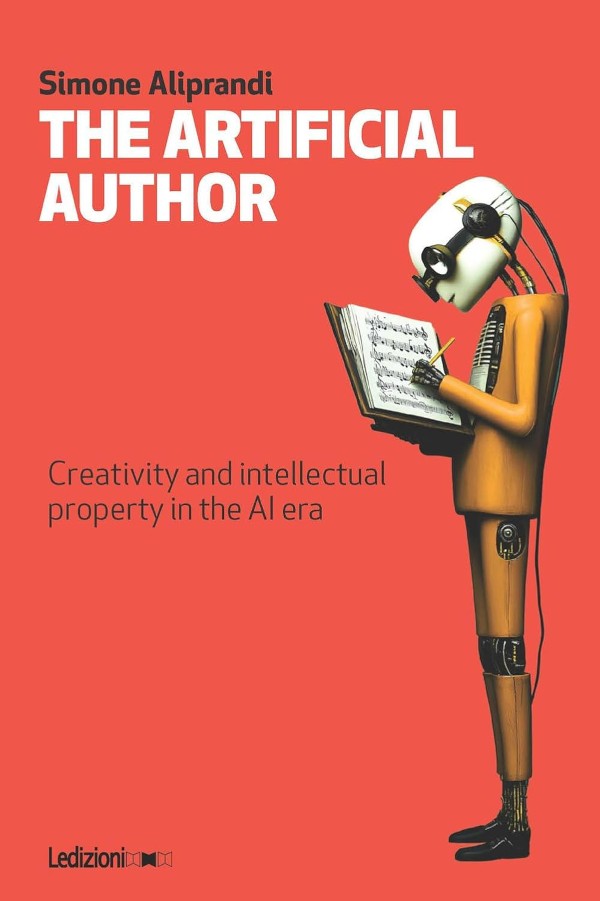
I recently finished reading Simone Aliprandi’s second edition of a book I would recommend to many people interested in either authoring software and databases or making creative works. ‘The Artificial Author’, as its title suggests, deals with the role of generative AI in creative jobs seen from a legal point of view. This massive book seeks to shed light on a central yet complex issue that, in recent years, has affected many people, not only in the IT sector but also across many sectors of the creative industry.
As often happened in the past, technological changes largely anticipated society's ability to adapt to new developments, particularly in high-impact areas such as copyright, intellectual property, and privacy. Frankly, it is impossible to cover in this review all the aspects of Aliprandi's work that it touches on and explains. Of course, the book is purely informative, but it summarizes where we are currently, from the perspective of legal implications for code and other content generated by AI tooling. The topic is an open problem for several reasons, including the undeniable fact that copyright legislation and the legal systems vary from country to country. So, for instance, what can apply in the US needs to be reconsidered for Europe. Actually, a series of legal trials is still ongoing since the start of the main new AI wave in the autumn of 2022, and some of them have not been finalized or reached an out-of-court (and so off-record) settlement.
That’s significant in common-law systems like the US's, while in Europe, the whole process is much slower and settles based on principles and legislation, not specific trials. The questionable points are:
- Is the whole training process for deep learning networks indeed legitimate under the fair use right? In most cases, it seems so, given the current state of things.
- Who owns the AI-assisted outputs, and are they copyrightable? The safest answer is: it depends.
- Should/could the AI outputs be considered derivative work? Moreover, if legally possible, should it be considered legitimate under any conditions?
- If the outputs of independent prompts and refinement are somewhat similar, is there any condition of plagiarism?
- Is there really any hope of a clean-room implementation, or even a fully original one, with AI tooling?
While it is clear that a fully AI-created work is not copyrightable under US law, the legal implications of a human-in-the-loop approach remain nuanced at this time. For sure, it seems that a simple prompt is not enough to claim rights on anything, and the whole process should be qualified by a significant human contribution. In the US, the meaning of copyrightable creative works implies involvement of skills, labor, and judgment by a person, and a simple prompt is simply not enough in most cases.
That also explains why, in some contexts, AI tooling should be considered with a grain of salt, and, for sure, the use of any AI-assisted contribution to co-authored/commissioned work should be clearly announced and stated as admitted: it could have future (if not current) impacts on authors' copyright claims.
Specific book sections also address recent European regulatory actions, as well as a general overview of pending and interesting litigations in the field in the European context. Indeed, the EU AI Act deals mostly with privacy.
I strongly suggest that interested people have a deep look at Simone’s book, because I have read too many naive claims here and there on the net about this matter. Of course, what is legally admitted could also be illegitimate or unethical, but prospects and past experiences (even considered in the book) are about future trade-offs and proper alignment, even for aspects such as laws and authors' expectations. For sure, this second edition will not be the last and definitive one for this book: we will see many sentences and regulations written in the near future, and the whole matter is in evolution, but it will still require years to settle.
For comments, join the discussion on Mastodon.